

Michigan Democratic Senate candidate Abdul El-Sayed's campaign has paid $82,500 to a Detroit religious organization that state records show was dissolved more than a decade ago. And the pastor running it has some explaining to do.
Abdul El-Sayed, or "AES," has a problem with Black voters in Michigan. He's been dogged by questions about his anti-Israel stances– which tend to irk committed Christians, including in the Black community. As far back as December 2025, there was grumbling that an Arab-American might win a seat representing Michigan in the U.S. Senate before an African-American would, despite Detroit's large Black population and Motown legacy. Michigan ranks 16th for the highest proportion of Black residents, nationally, but is also known for its large Arab-American population.
As a way of assuaging concerns, AES has tried to emphasize his "African" heritage as an American of Egyptian descent.
Key to solving his Black voter problem has been one pastor in the community. But the "fix" hasn't come cheap– or from a community leader free of his own baggage.
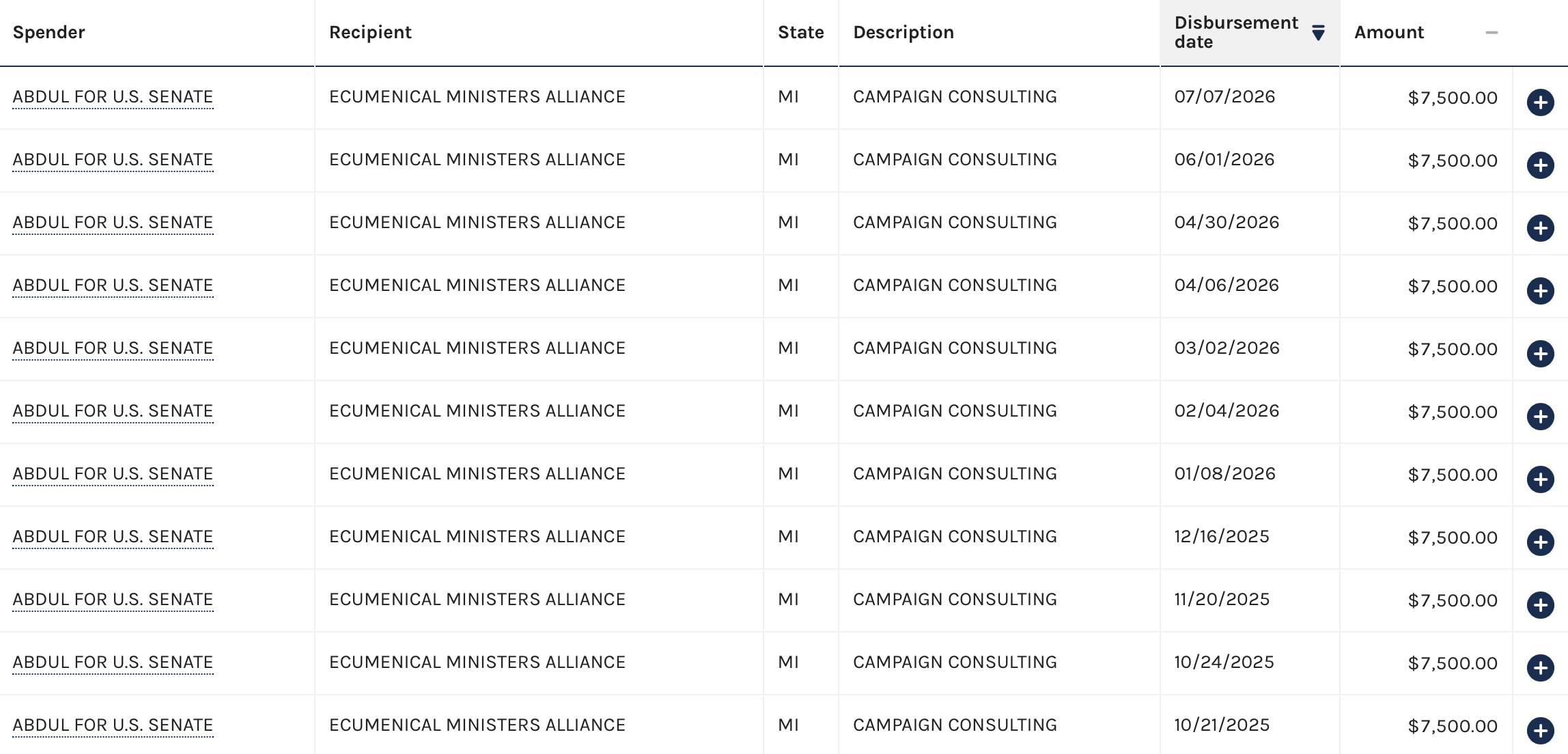
According to Federal Election Commission records, AES' campaign has paid $82,500 to the Ecumenical Ministers Alliance (EMA), a Detroit-based organization headed by Rev. Horace Sheffield III.
There's just one rather significant problem.
Michigan corporate records show the organization was dissolved all the way back in 2014.
A search of the Michigan Department of Licensing and Regulatory Affairs business registry identifies the Detroit Ecumenical Ministers Alliance as a domestic nonprofit corporation formed September 8, 2010.
Its status? "Dissolved - Operation of Law."
Its annual report standing? "Not Good."
Its last reported filing with officers and directors? 2011.
The organization was officially listed as inactive on October 1, 2014.

Yet more than a decade later, the El-Sayed campaign is sending tens of thousands of dollars to an organization operating under the same name.
And that's where things get interesting.
$82,500 for What, Exactly?
The Washington Free Beacon reported that Sheffield hosted AES at a clergy roundtable as the candidate struggled to connect with Black voters.
But Sheffield isn't simply a pastor offering El-Sayed a friendly introduction.
On June 24, 2026, Sheffield announced on Facebook that the Ecumenical Ministers Alliance was endorsing El-Sayed.
That raises two obvious questions: Was AES' $82,500 payment a straight-up purchase of an endorsement? And does AES have any notable Black church backing that he has not bought and paid for?
FEC records current as of yesterday identify the El-Sayed campaign as the only federal committee reporting payments to Sheffield's "organization" during the 2025–2026 election cycle.
Searches of Michigan's charitable organization registry and the IRS tax-exempt organization database do not turn up an active organization under the name Ecumenical Ministers Alliance.
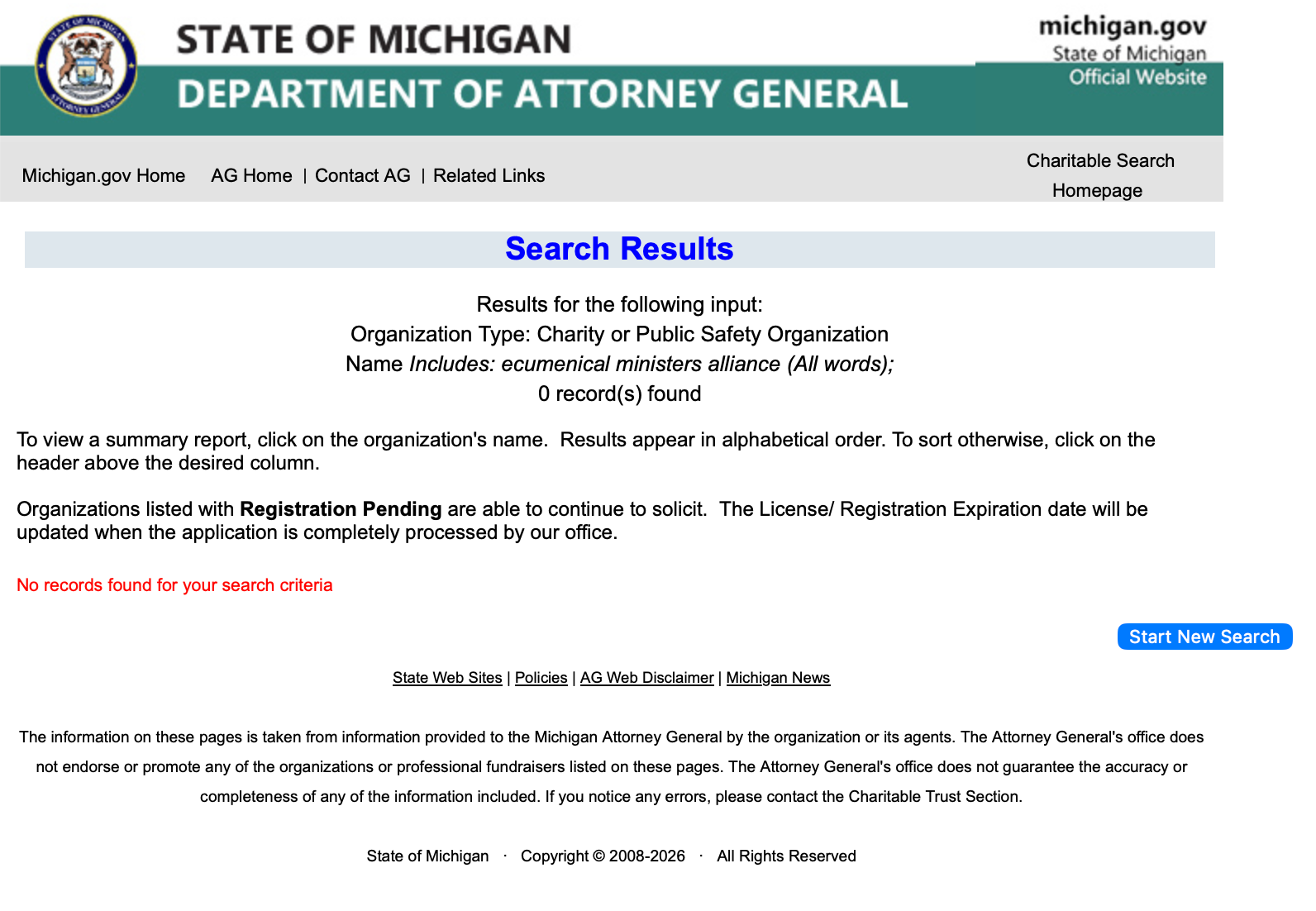
Sheffield's own website describes him as chairman of the alliance. But Michigan's corporate registry shows no current filings identifying its officers, directors, or governing board.
So who are the ministers in this alliance? Who sits on its board? And what services justify $82,500 in campaign spending?
Those are questions El-Sayed's campaign should answer. The available documentation as of now indicates that, at best, the Ecumenical Ministers Alliance is a "trade name" for Sheffield, personally, and not a legitimate group as a matter of corporate law, or non-profit tax law.
And as a matter of federal campaign finance law, endorsements that are bought and paid for are required to be disclosed.
Back in 2015, Jesse Benton, an operative in the Ron and Rand Paul universe, was indicted for concealing the true nature of payments to an Iowa senator who switched his support from Michele Bachmann to Ron Paul ahead of the 2012 Iowa caucuses.
While the fact pattern here differs, the fundamentals appear the same: FEC paperwork does not indicate AES' campaign paid $82,500 to the defunct group– now de facto operating as a for-profit venture on Sheffield's part– for an endorsement.
Rather, the FEC file says that Sheffield, operating as the Ecumenical Ministers Alliance, was paid for "campaign consulting."
Meet Rev. Horace Sheffield III
Sheffield is something of a celebrity in Detroit politics.
He's a longtime pastor and community activist who has been involved with several nonprofit organizations, including DABO Detroit, whose filings are up-to-date in its registration with Michigan's Secretary of State.

He's also listed as treasurer of Premiere Quality Health Center Inc., another Detroit nonprofit, according to the organization's records. That entity is also up-to-date in its registration with Michigan's Secretary of State.

That makes the Ecumenical Ministers Alliance's corporate status all the more curious.
Michigan's business registry identifies Sheffield as the Alliance's resident agent and lists his Detroit address as its registered office.
Sheffield has publicly identified himself as the organization's chairman, even though its corporate registration has been inactive for approximately 12 years.
Clearly, Sheffield or people he works with have the capacity to properly maintain corporate registrations and records; the Premiere Quality Health Center Inc. filing indicates as much. They simply appear not to have filed the right paperwork or paid the right fees with regard to the Ecumenical Ministers Alliance– for well over a decade now.
Sheffield told the Detroit News he would have "them" look into the matter of the Alliance's corporate records when previously called on filing problems. It is unclear who "them" referred to in that context.
The Endorsement Business
For El-Sayed, the political benefit to paying off Sheffield is obvious.
A candidate struggling to build support among Black voters can point to the endorsement of something called the Ecumenical Ministers Alliance and present it as evidence of support from Detroit's Black, Christian community.
But a name isn't a congregation– or, in this case, even more than one individual member. And an endorsement from an organization whose corporate registration was dissolved in 2014 doesn't establish how many pastors, churches, or congregants actually support the candidate.
El-Sayed's campaign has spent $82,500 on the alliance. Sheffield has delivered an endorsement and helped arrange access to clergy.
What remains unclear is precisely what the campaign received for that money, who authorized the endorsement on behalf of the alliance, and whether the organization has any functioning corporate structure.
The El-Sayed campaign is paying real money to an organization whose official corporate existence ended more than a decade ago.
Michigan voters deserve to know what AES thinks he's getting for it.

Comments ()