
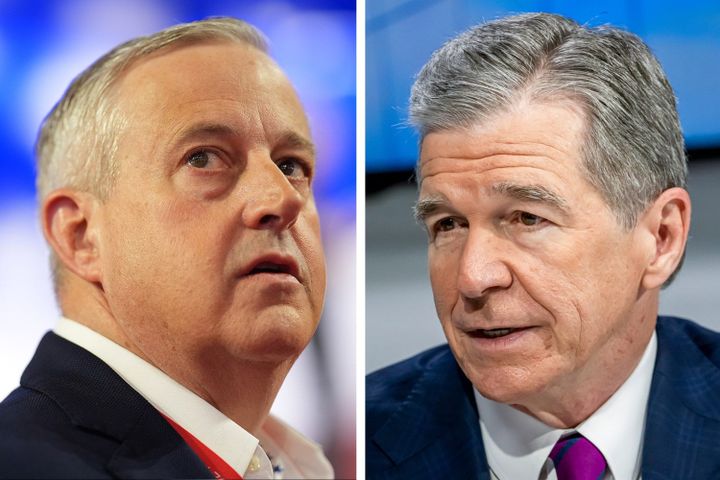
Yesterday, Crimson Hub broke news that Not-A-Joe-Manchin-Clone Fake Conservative Democrat Roy Cooper maintains millions of dollars in investment funds run by Environmental, Social, Governance (ESG) banking giants.
This morning, in an unforeseen twist, a tipster alerted us to an even bigger liability on Republican candidate Michael Whatley's part: In addition to maintaining his own ESG investments and having represented numerous green energy interests as a "government relations professional" (heh), Whatley is still being paid for his work as a green energy lobbyist.
On August 13, Whatley filed his most recent personal financial disclosure form (PFD).
In addition to showing something between $134,000 and $410,000 that Whatley has invested in two Vanguard funds, Tesla, GE Aerospace and GE Vernova, Whaley's PFD shows that he was paid at least $5,000 during the relevant period by each of his former lobbying firm, CAPCVentures, and GE Vernova, Centrus Energy Corp., and the Renewable Fuels Association.
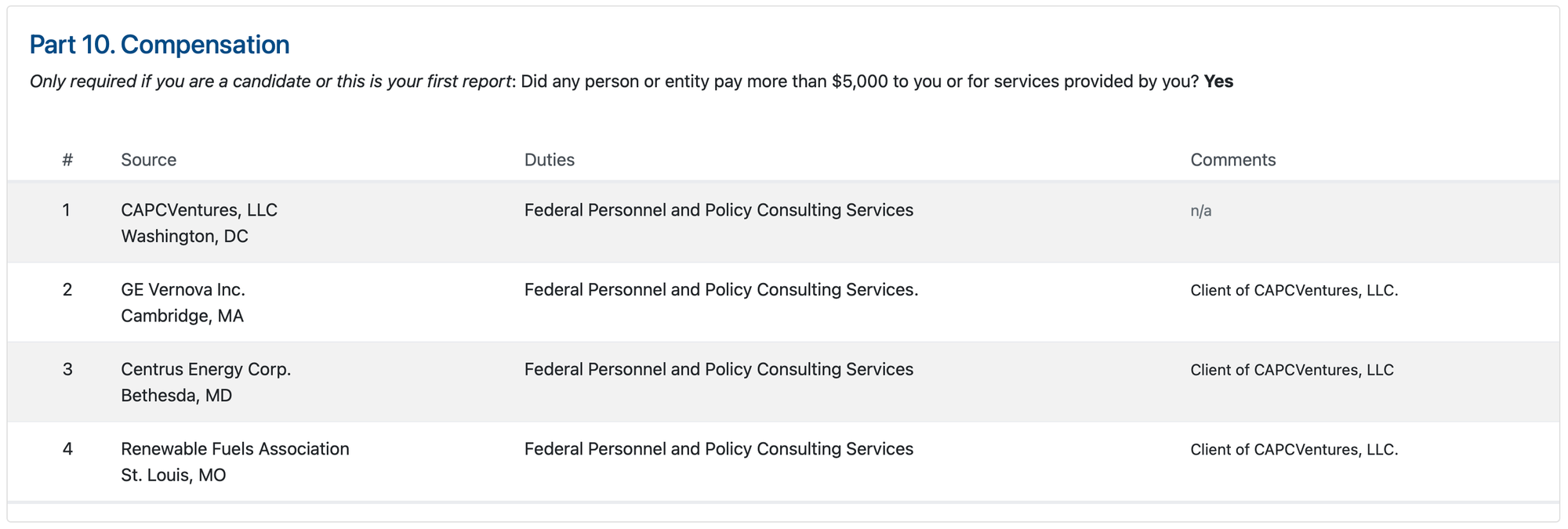
And what do those clients do? The short version is: Green energy and decarbonization.
GE Vernova describes itself this way on its corporate website: "At GE Vernova, we are united by a single, urgent, and optimistic mission: electrify to thrive and decarbonize."
The website adds that in GE Vernova's view, "The world needs us to accelerate the transition to more reliable, affordable, and sustainable energy."
Vernova is also heavily invested in providing "data center solutions."
Centrus is a nuclear energy company (nuclear is a major rival to natural gas; the two branches of the energy sector have been feuding for at least a decade now over everything from how to power data centers to the UAMPS nuclear proposal in Utah).
And the Renewable Fuels Association is the trade association that advocates for ethanol mandates and regulatory subsidies.
Ethanol blending requirements have been a long-favored green energy policy advocated by Democrats, most notably former President Barack Obama and former President Joe Biden, who set them at a very high level during his presidency.
But those mandates are currently being blamed for adding between 20 cents and a dollar to every gallon of gas in North Carolina. Truckers also revile them because they're driving diesel costs up.
Whatley has a lengthy history in green energy lobbying. As the Washington Examiner reported late last week:
Having worked as chief of staff to former Sen. Elizabeth Dole, who, like Tillis, hewed to the left of the party on green energy, it was perhaps no surprise that Whatley subsequently became an energy lobbyist who advocated a boatload of green energy causes. But while that might have sold in the 2006-2008 incarnation of the GOP, the 2026 edition is different. Tillis found this out when he decided to oppose Republicans’ One Big Beautiful Bill Act, which, among other things, slashed Biden-era green energy subsidies.
Lobbying disclosures show that Whatley lobbied for Exxon Mobil and General Electric while both were publicly pushing Congress for mandatory carbon caps and cap-and-trade. In 2008, he became executive vice president of the Consumer Energy Alliance. Environmentalists portray the group as a fossil-fuel front, but the CEA notably spent years pitching solar and wind on its website and praising the Obama White House’s rooftop solar panels. In 2022, the CEA said it was “pleased” with the Inflation Reduction Act, calling then-President Joe Biden’s signature climate law “a sign of progress.” Whatley also backed regulatory ethanol subsidies that were originally advanced on environmental grounds and championed by none other than then-Sen. Barack Obama, while having been broadly opposed on the Right by figures such as Sen. Ted Cruz (R-TX) and the Heritage Foundation. Those regulatory subsidies are estimated to be costing each North Carolinian about $200 per year.
Now, as the Examiner noted, Whatley has lobbied for more conventional energy interests, too (notably the offshore oil drillers).
But that's not where he's making his money now– or at least not enough of it to have to break it out on a separate line item on his PFD.
It's pretty astonishing that the upshot of this Senate race could be replacement of Thom Tillis with a senator who is even more cozy with green energy interests than the man who voted against the partial repeals of green energy subsidies in Biden's so-called "Inflation Reduction Act" was.
But that's where it looks like the state is headed, whether Cooper or Whatley wins.
When this race is done and dusted, the NCGOP really needs to clean up its act, and the national Republican Party organizations need to start vetting candidates well before they jump into races again.


Comments ()