

Former North Carolina Governor Roy Cooper is running for North Carolina's open Senate seat.
As part of that effort, Cooper is trying to project an image of himself as the second coming of former West Virginia Senator and conservative Democrat Joe Manchin.
But Cooper's investments tell a different story: It turns out the Democrat has plowed tons of money into funds managed by ESG (Environmental, Social, Governance) investment titans.
Cooper filed an updated personal financial disclosure form (PFD) with the United States Senate on August 13. On that PFD, Cooper discloses between $2,605,039 and $5,876,001 invested with two investment houses: Vanguard and Charles Schwab. Both have prioritized ESG investing heavily in recent years.
None of Cooper's money sits with explicitly branded ESG funds offered by either Schwab or Vanguard.
Recent years have seen a push from conservatives and traditional investment strategy advocates for divestment from Vanguard funds, specifically, though less so Schwab.
Of Cooper's total investments, $1,284,013 is held with Vanguard, specifically.
Back in 2023, Cooper vetoed anti-ESG leislation passed by the state legislature.
The North Carolina legislature overrode that veto.
North Carolina Treasurer Dale Folwell called the override a move against "Wacktivism."
"The best interests of North Carolina taxpayers and retirees will be served through legislative passage of House Bill 750, which requires investment decisions to be made on the basis of the highest financial returns, not social and political 'wacktivism,'" said Folwell.
“This is a good day in North Carolina. We are grateful to those lawmakers who understand the need to shield the state pension plan against the movement to weaponize public retirement systems to achieve extreme agendas,” Folwell continued.
Cooper disagreed. He holds at least $250,001 in three Vanguard funds: VYM (Vanguard High Dividend Yield ETF), VTIAX (Vanguard Total International Stock Index Fund Admiral Shares), and VTSAX (Vanguard Total Stock Market Index Fund Admiral Shares). None of those are explicitly ESG funds, but they are Vanguard investments.
Of note, Cooper is not the only candidate in this race with an ESG investment problem: As the Washington Examiner reported late last week, "Senate disclosures show six-figure holdings in Alphabet and Microsoft, tens of thousands more in pharmaceutical companies such as Pfizer and Merck, and over $130,000 in green and environmental, social, and governance-aligned funds, on top of shares in Yum China."
What are those investments? Whatley's latest PFD shows the following:
- Between $100,001 and $250,000 in Vanguard's VTTHX - Vanguard Target Retirement 2035 Fund
- Between $1,001 and $15,000 in Vanguard's VIOO - Vanguard S&P Small-Cap 600 ETF
- Between $1,001 and $15,000 in Tesla
- Between $16,001 and $65,000 in GE Aerospace
- Between $16,001 and $65,000 in GE Vernova.
So that's less in total than Cooper, but unlike Cooper, it includes three explicit green stocks.
What's funny here is that Cooper's investments arguably prove correct critics' point about ESG investment houses' flawed approach– a point Cooper has been reluctant to take on board.
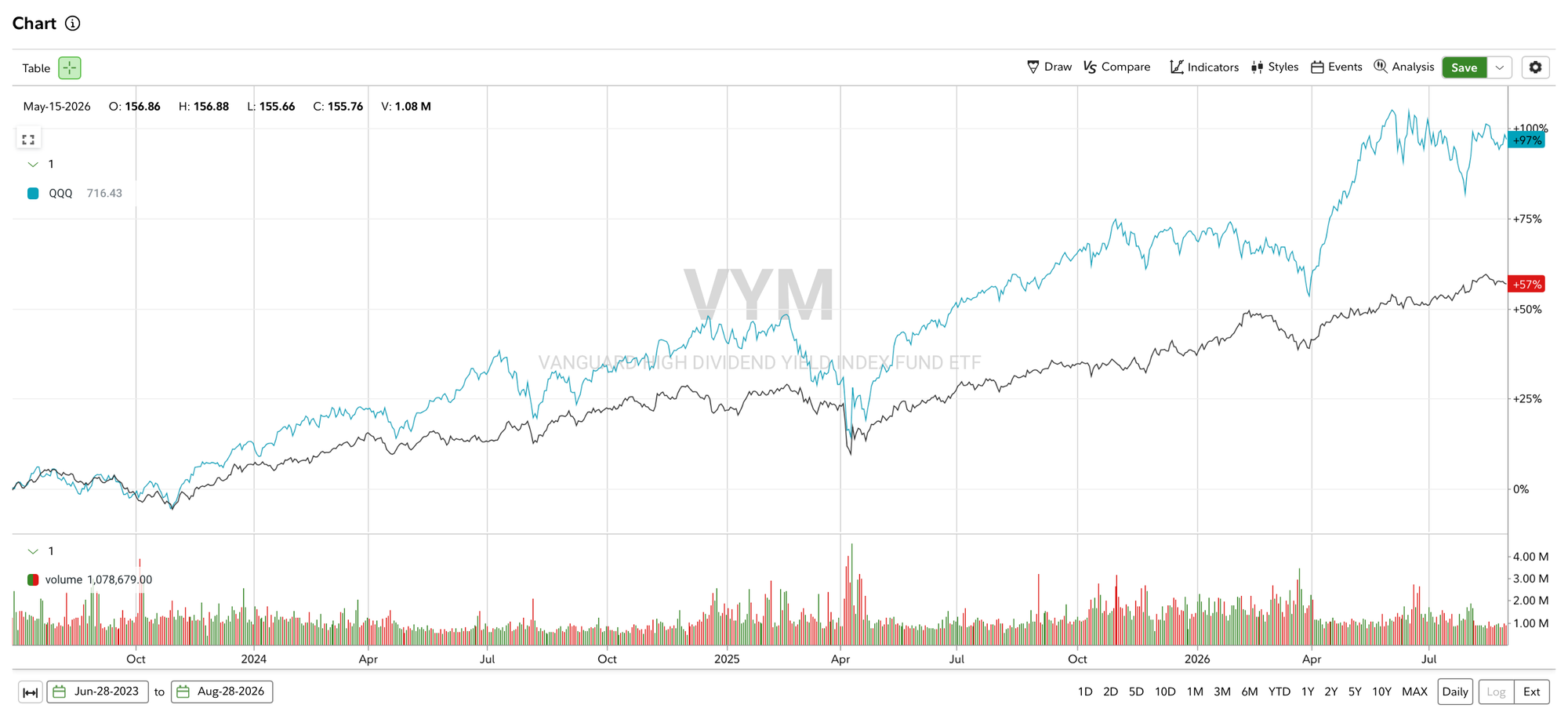
Here's what would have hypothetically happened to $10,000 invested in Cooper's VYM (Vanguard High Dividend Yield ETF) (black line) versus Invesco's QQQ fund (blue line) since the date of Cooper's veto of the anti-ESG bill.
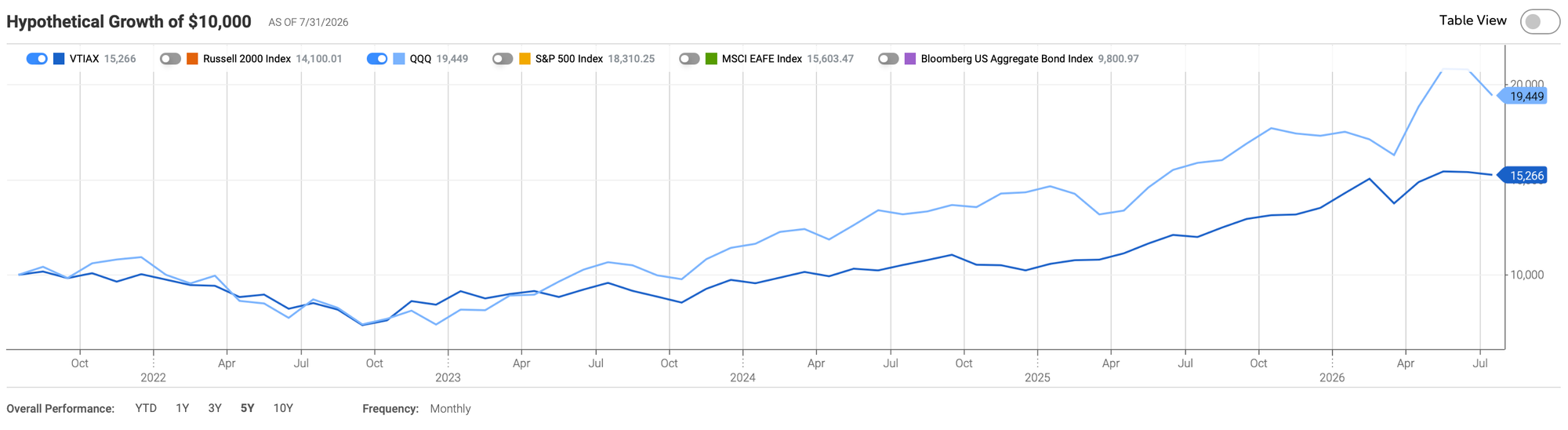
Here's what would have hypothetically happened to $10,000 invested in Cooper's VTIAX (Vanguard Total International Stock Index Fund Admiral Shares) (dark blue line) versus Invesco's QQQ fund (light blue line) over the past five years (VTIAX's different structure means a different method of display with Fidelity).
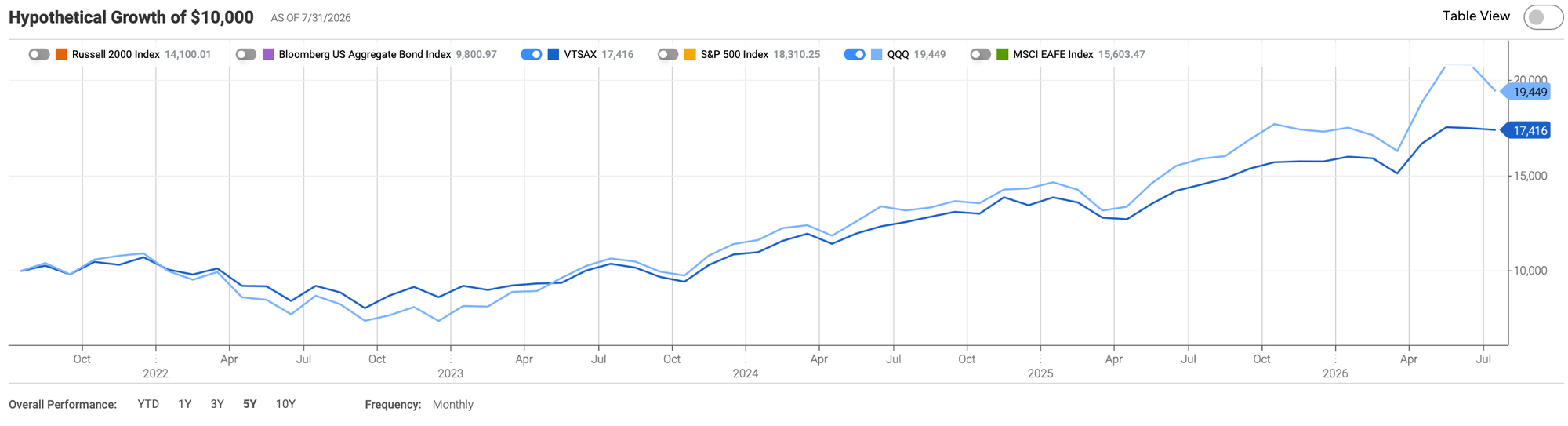
Here's what would have hypothetically happened to $10,000 invested in Cooper's VTSAX (Vanguard Total Stock Market Index Fund Admiral Shares) (dark blue line) versus Invesco's QQQ fund (light blue line) over the past five years.
Whoever wins the North Carolina Senate race (and let's be honest, it's likely Cooper) won't have much of a role to play in steering pension fund investments into politically correct or incorrect directions. That's much more a matter for state-level officials.
They will, of course, cast votes that impact the US' credit rating, interest rates on the federal debt, and therefore interest rates on Americans' mortgages and credit cards.
What Cooper's portfolio tells us most of all where those topics are concerned is that he's much better-positioned to weather an economic downturn, personally, than the overwhelming majority of Americans– but also that he could have been even better-positioned if he had put his money in QQQ rather than putting the biggest chunks of it into these Vanguard funds.
But isn't that just like a classic Democrat to miss opportunities to bank better financial returns because they were more interested in palling around with the "cool kids?"

Comments ()