
Members of Congress pushing a proposed health care "improvement" bill took hundreds of thousands of dollars in combined donations from the very industry that would benefit from the legislation they recently introduced, a Crimson Hub analysis has found.
The analysis could further entrench concerns that the pharmaceutical industry is seeking to dictate health care policy at a time when both the Republican and Democratic bases view the sector unfavorably and have voiced skepticism about its outsized impact on US politics and policy.
On July 6, Reps. Scott Peters (D-CA) and John Joyce (R-PA) introduced legislation known as the SECURE 340B Act, co-sponsored by Reps. Jake Auchincloss (D-MA), Dan Crenshaw (R-TX), and Nanette Barragán (D-CA).
The bill authors describe it as a bipartisan effort to "modernize the 340B Drug Pricing Program."
But in practice, the bill appears focused on narrowing the definition of a "patient" for the purposes of federal law in a way that would limit safety net health care providers from acquiring drugs from manufacturers at a discount, as federal law currently requires when those manufacturers also bill taxpayer-funded entitlement programs for sales to seniors and people on Medicaid.
It also appears directed at preventing patients from accessing a discount on their medication if a provider whose pharmacy dispenses it has also obtained that medication at a discount, or blocking safety net providers' pharmacies from acquiring drugs at a discount when a pharmaceutical manufacturer is offering a discount directly to patients. A release announcing the bill states that "the federal government still has no uniform way to prevent...duplicate discounts," suggesting that drugs being sold for less, not more, is somehow a problem despite widespread voter angst about the cost of living and inflation.
Many drugmakers currently deny such duplicate discounts as a matter of their own internal policies, but want the restriction written into federal law to provide legal cover for what are now commercial-only, profit-driven decisions. The release touting the bill also suggests that patients, especially in California, skip medication because drug prices are too high. That claim sits awkwardly next to a bill aimed at further limiting, not extending, discounts. It's also worth noting the high cost of living in California is being driven largely by excessive regulation, taxation, and anti-development attitudes among progressive power brokers.
In short, Big Pharma critics argue the bill is a giveaway to drugmakers.
That may come as little surprise given how much each co-sponsor's campaign has benefited from drug manufacturer largesse.
Open Secrets data shows Peters has already taken in $59,725 in donations from pharmaceutical manufacturers this cycle, about $50,000 of which came in the form of PAC donations. In 2024, he raised $104,526 from the same sector, with $99,500 coming from PACs. In 2022, Peters' pharma sector money totaled $151,710, again with the overwhelming majority coming from PACs.
Joyce has brought in $76,000 from pharma donors this cycle, plus $82,050 in 2024 and $49,500 in 2022. Most of this money also came from industry PACs.
Crenshaw has taken less, though his lighter 2026 total may reflect his primary loss earlier this year. Over the past three cycles, Crenshaw has banked about $75,000 from drugmakers.
Nanette Barragán has brought in $22,500 in 2026, all of it PAC money, plus $66,400 in 2024, and $27,500 in 2022, also all PAC money.
Auchincloss has banked $55,250 from pharma interests so far in the 2026 cycle, after raising $31,180 in 2024, and $20,600 in 2022.
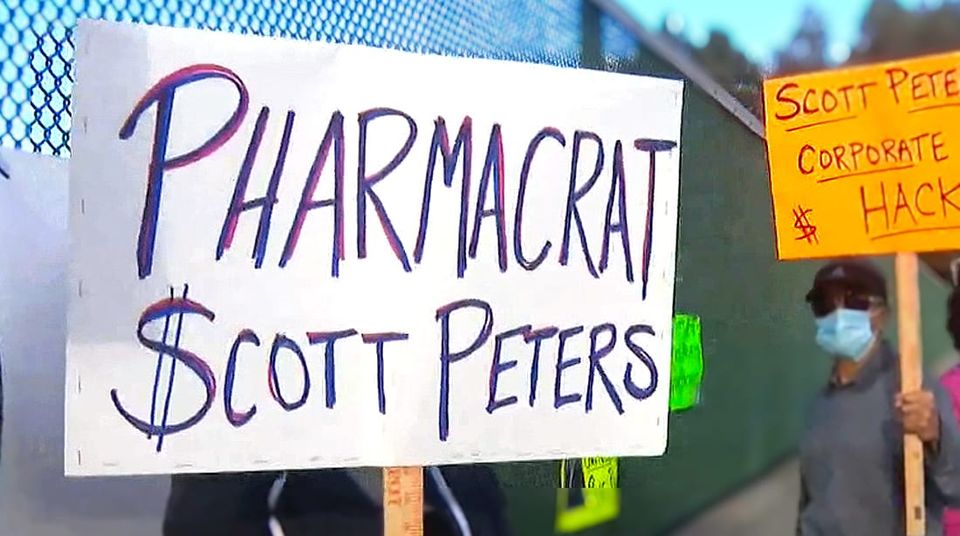
Peters, especially, has previously taken heat for efforts to dismantle the drug discount program in question, most notably from the AIDS Healthcare Foundation.
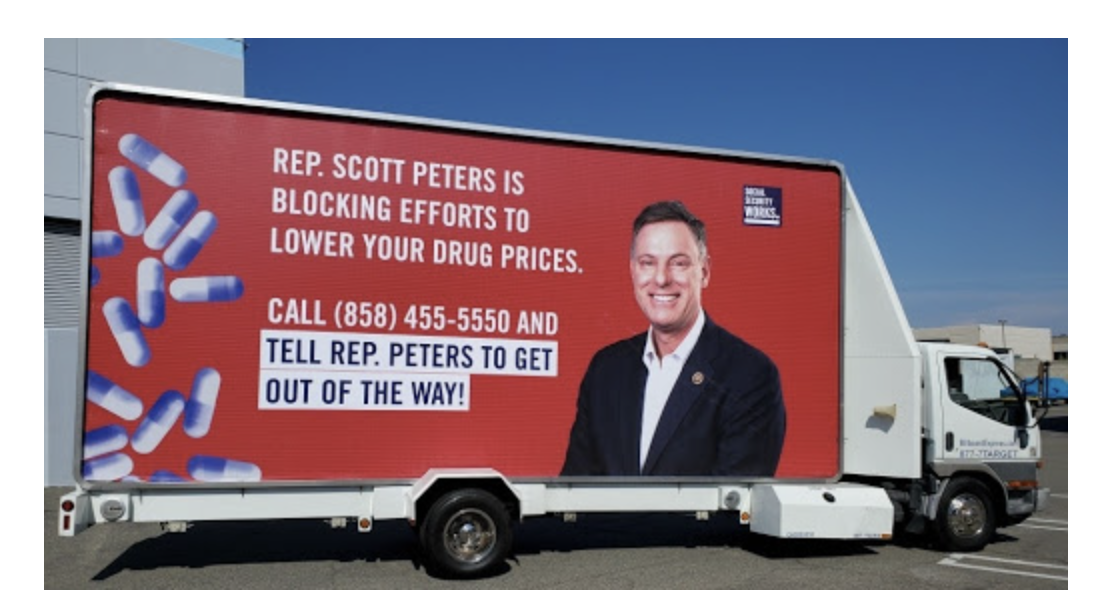
In 2021, the organization led protests targeting Peters featuring a mobile billboard accusing him of blocking efforts to lower pharmaceutical prices.
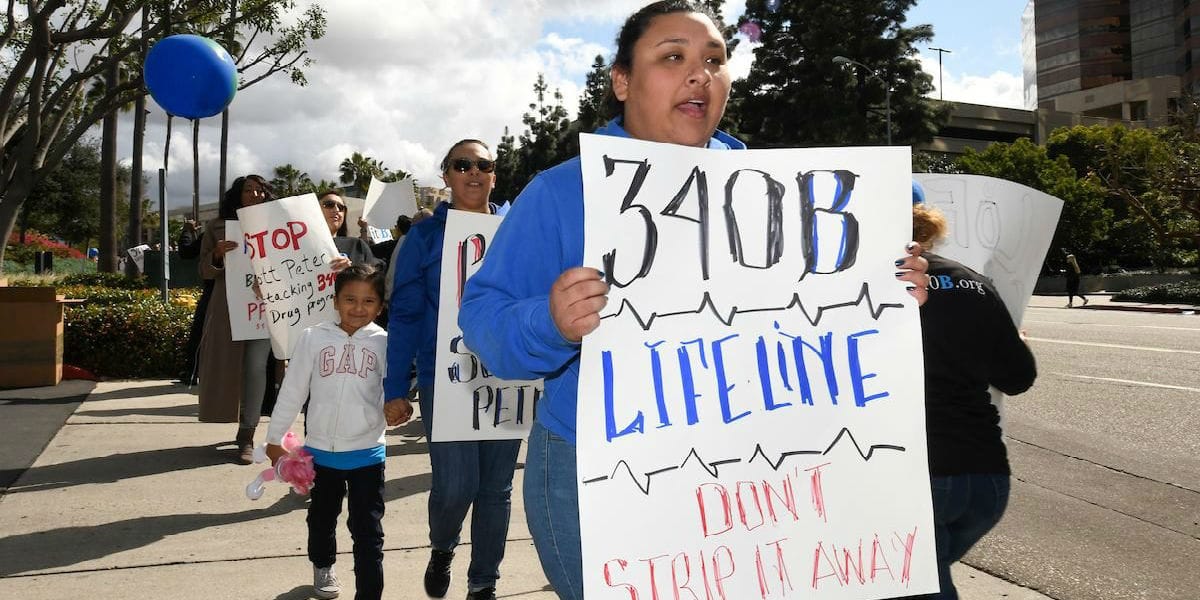
In 2018, 200 picketers also organized by AHF protested Peters' district office over his assaults on the same drug discount program now in the crosshairs of his SECURE 340B Act.
Among the health care providers who could be adversely impacted by the SECURE 340B Act are HIV and AIDS clinics, including Ryan White clinics, and rural, red state hospitals serving predominantly working class voters, also known as MAGA voters. Notably, states like Louisiana, Arkansas, Mississippi, West Virginia, and Missouri have taken steps to protect, not restrict, the drug discount program. During his first administration, President Trump instituted ceiling prices for drugs within the program, further bolstering it.

Comments ()